Nova Reactor
The Nova Reactor turns fuel into heat and heat into FE. Temperature, cooling and waste management are essential parts of operating it.
Build the 3×3×3 structure
The top and bottom layers are solid 3×3 Machine Casing. The middle layer has a Nova Reactor Core in the center, a Nova Reactor Controller in the middle of one outer face, and casing around it. The core must be in the center.
Top / bottom       Middle, example
C C C              C E C
C C C              I R I
C C C              C T C

C = Machine Casing     R = Reactor Core
T = Controller         E = Energy Port
I = Item Port

Item Ports and the Energy Port can swap positions.
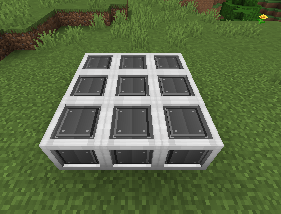
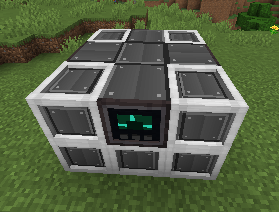
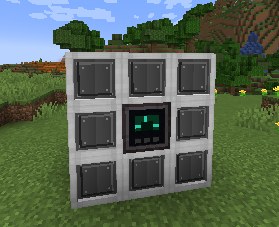
The middle shell accepts at most one energy port and two item ports. Use the energy port for FE access, and input/output item ports for supply and waste removal. The example uses both item ports, one for each direction.
Supply fuel and coolant
| Resource | Function | Internal value |
|---|---|---|
| Blackhole | Fuel | 10,000 fuel units per item |
| Nova Bar | Coolant | 5,000 coolant units per item |
| Exotic Dust | Extracted waste product | Removes 5,000 waste units per item |
An input-mode item port accepts supplies; an output-mode item port exposes waste. Fuel and coolant each hold up to 1,000,000 units; waste holds 100,000. During burning, fuel consumption is 20 units/t and waste production is 10 units/t. Coolant demand increases with core heat.
Control the temperature
Peak output is 4,000,000 FE/t, with an ideal temperature of 25,000 K. Output also depends on the reactor's state and calibration. Its energy buffer holds 10 billion FE.
Use Controller rules to limit Core Heat, Casing Heat and Waste, and to require sufficient Fuel and Coolant. A reasonable starting plan is to stop burning before the dangerous temperature range and allow it to resume only after cooling. Monitor both temperatures rather than treating stored FE as a safety indicator.
Meltdown
At a core temperature of 45,000 K or higher, the reactor can enter a destructive meltdown. Do not use this threshold as your normal shutdown target. Stopping burning does not instantly remove stored heat.
Cooling and residual-heat generation continue when control pauses the reaction. Keep the energy output and waste extraction available, and verify supply before leaving the installation running.